
Agricultural Drone Market (2022 - 2032)
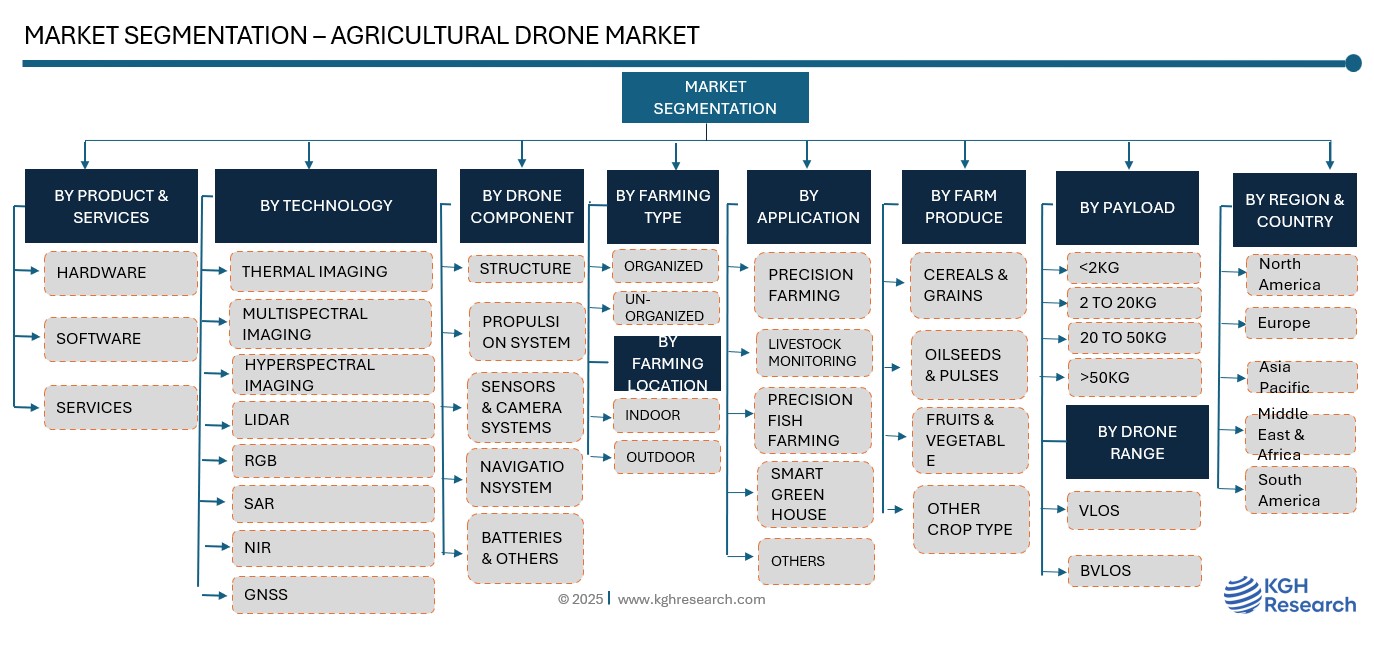
AGRICULTURAL DRONE MARKET SIZE & SHARE BY APPLICATION (PRECISION FARMING, LIVESTOCK MONITORING, SMART GREEN HOUSE, OTHERS), BY PRODUCTS & SERVICES (HARDWARE, SOFTWARE, AND SERVICES), BY DRONE PAYLOAD (50KG), BY TECHNOLOGY (THERMAL IMAGING, MULTISPECTRAL IMAGING, HYPERSPECTRAL IMAGING, LIDAR, RGB, SAR, NIR, GNSS, AND OTHERS), BY RANGE (VLOS & BVLOS), BY DRONE COMPONENT (STRUCTURE, PROPULSION SYSTEM, SENSORS & CAMERAS, NAVIGATION SYSTEM, BATTERIES, AND OTHERS), BY AGRICULTURE PRODUCE (CEREALS & GRAINS, OILSEEDS & PULSES, FRUITS & VEGETABLES, AND OTHERS), BY FARM SIZE, BY FARMING LOCATION (INDOOR AND OUTDOOR), BY FARMING TYPE (ORGANIZED & UNORGANIZED), BY REGION & COUNTRY–FORECAST TO 2032
| Report Code: AGRI9001-0101 | Number of Pages: 400 | Report Format: PDF, EXCEL, PPT |
|---|---|---|
|
Trend Year: 2022 – 2024 |
Forecast Period: 2025 – 2032 |
Publish Date: JULY 2025 |
- Report Summary
-
Tables of Content
- Segmentation
- Methodology
- User License & Pricing
- Sample Copy
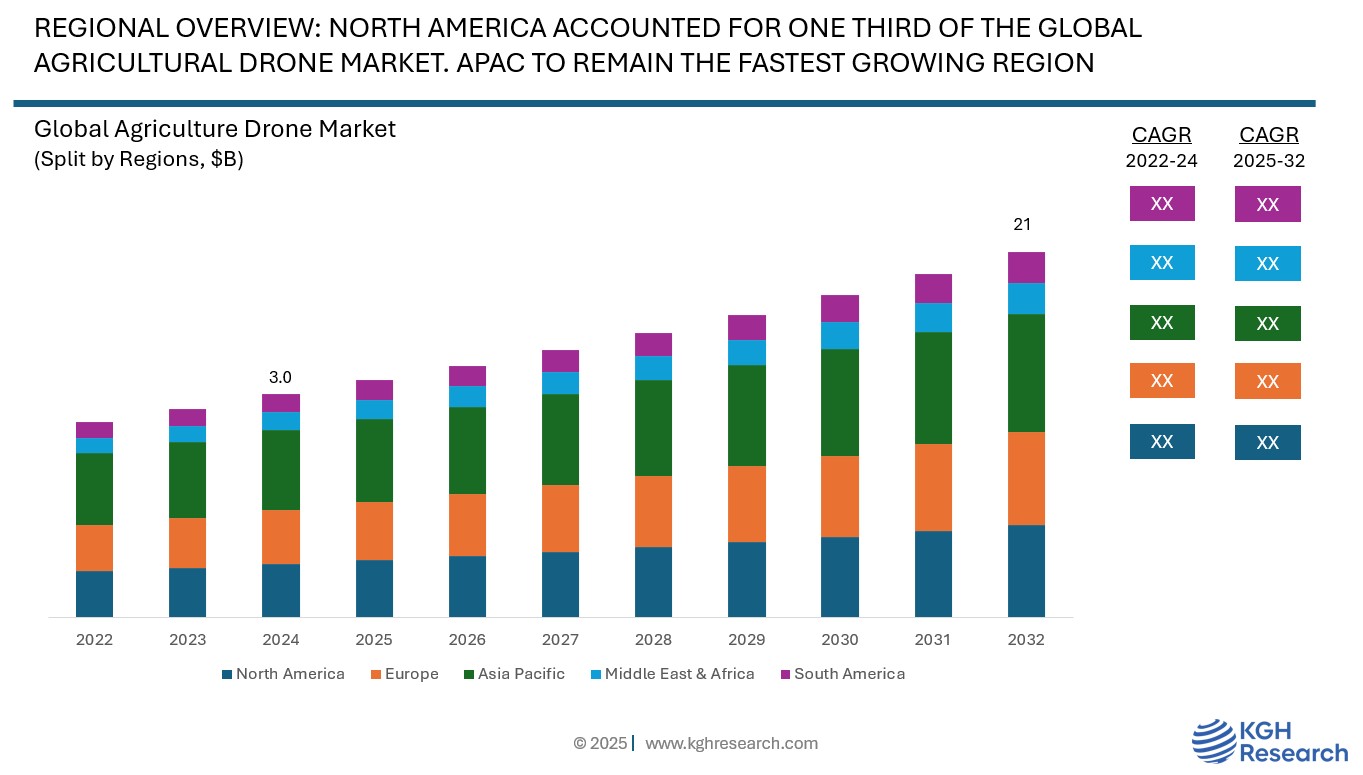
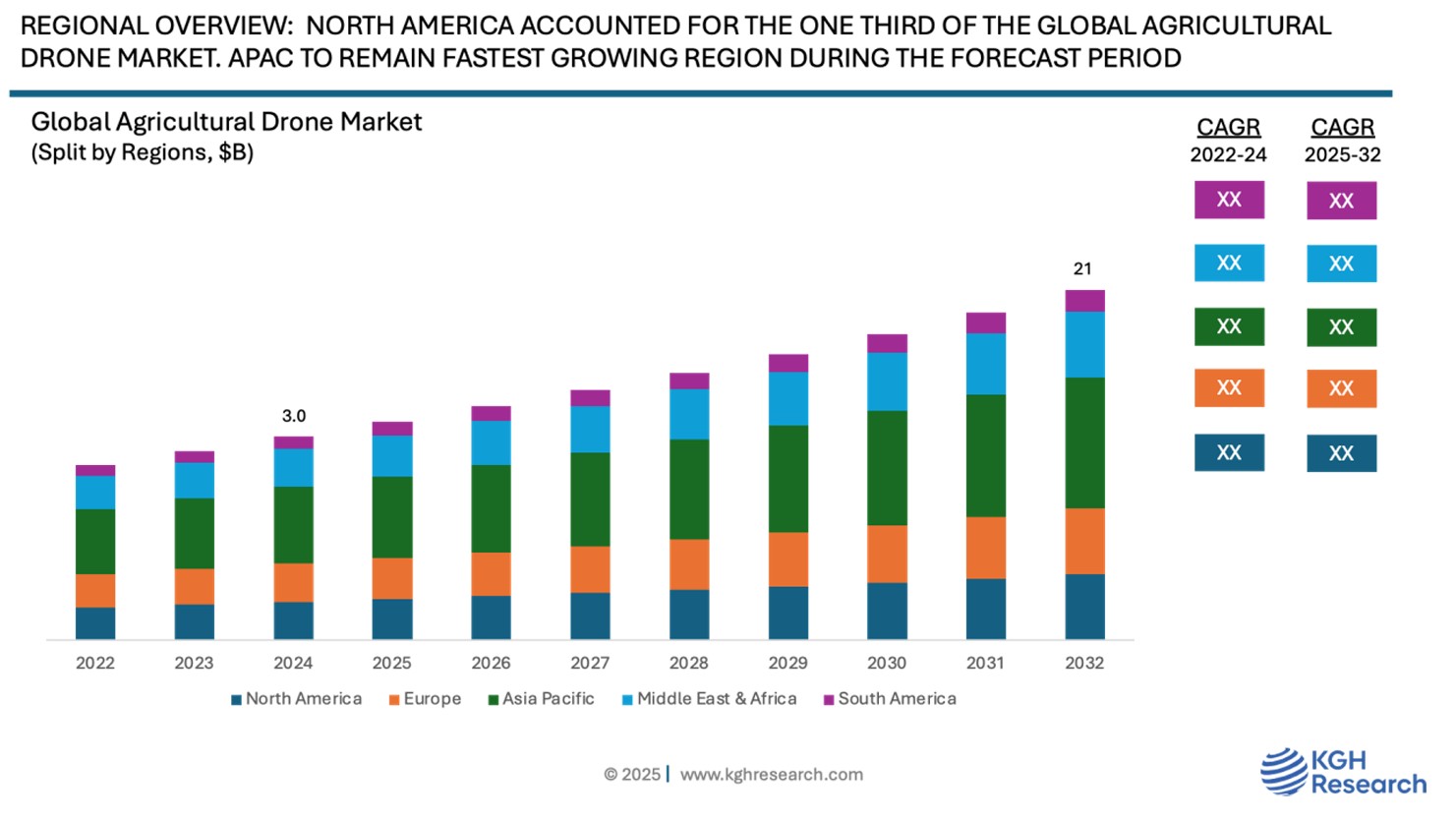
Market Overview: The global agriculture drone market was estimated at US $3.0 billion in 2024 and is projected to grow at a compound annual growth rate (CAGR) of more than 27% from 2025 to 2032, reaching US $21 billion by 2032. The agriculture drone market is undergoing rapid transformation as drone technology becomes a vital enabler of precision farming. Increasing pressure to boost crop yields, reduce input waste, and address labour shortages has led farmers to embrace unmanned aerial systems (UAS) for data-driven decision-making. Agricultural drones are now being used across the globe for crop health monitoring, field mapping, spraying, and surveillance. Supported by favourable government policies, incentives, cost reductions in drone hardware, and expanding AI and imaging capabilities, the market is expected to witness double-digit growth throughout the entire decade.
MARKET DYNAMIC
GROWTH DRIVERS:
- Increasing demand for agricultural produce to feed rapidly growing world population
- Government Support and Subsidies for Smart Farming, globally
- Affordability: As agriculture drones have become more affordable, their adoption has gained momentum
- Increasing farmers income with increased yield, reduced labour cost, effective utilization of resources
- Reducing risk of health hazard in farmers
NEW GROWTH OPPORTUNITIES:
- AI’s growing influence in agriculture: Deployment of advanced technology and growing usage of AI to ensure high quality production, increased productivity & yields, optimum utilization of resources, while maintaining farmers’ safety and soil health.
- Drone Tech Innovation: Development of batteries with higher service and operating life, lighter structure, and data analytic software enabling informed decision.
MARKET RESTRAINTS:
- Lack of Skilled Drone Pilots: The increasing adoption of agriculture drones underscores the need for more certified civilian drone pilots, that can effectively operate agricultural drones.
GROWTH HURDLES:
- Trade tensions, tariffs, and geopolitical instability likely to impact global supply chains, demand, production costs, and profitability of drone manufacturers, and associated partners in the supply chain.
- Security threat due to unauthorized usage of agricultural drones to carry out targeted attacks.
By Mode of Operation: Market Insights
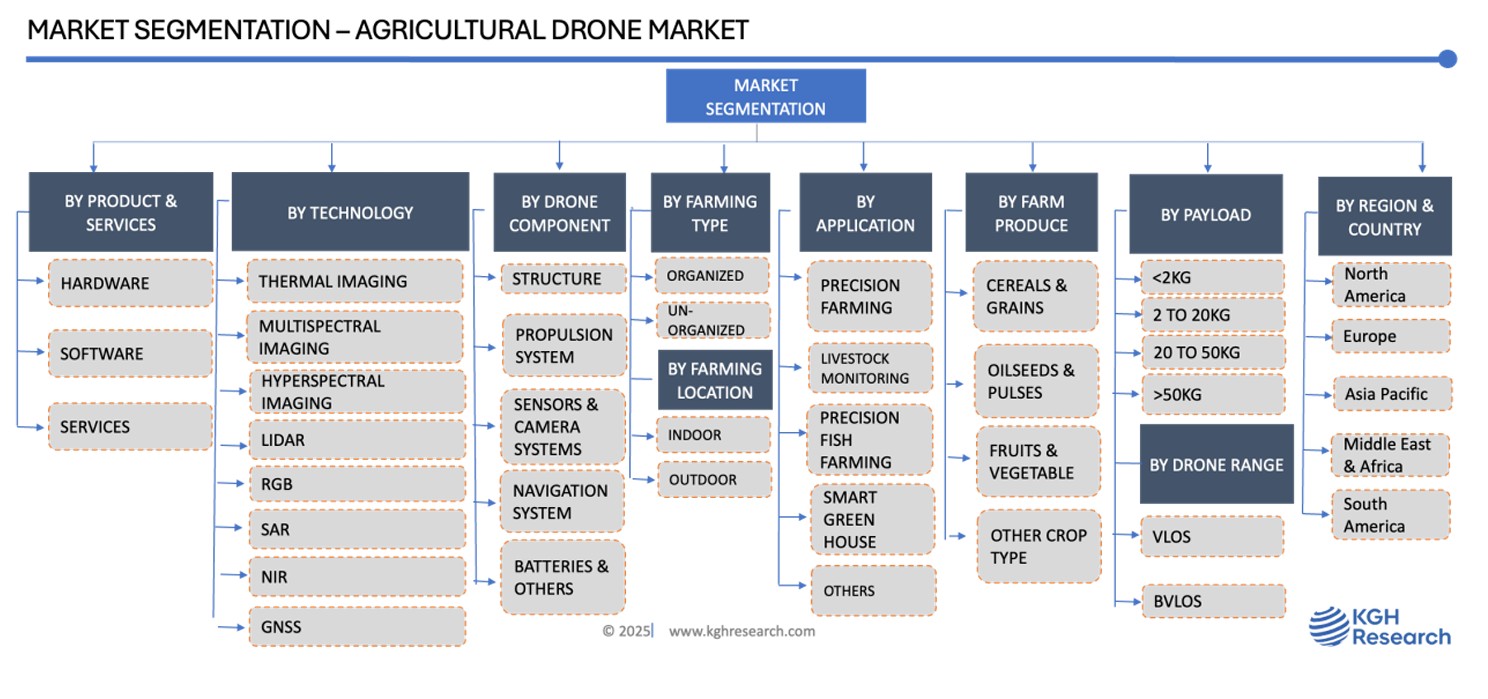
The agriculture drone market, based on mode of operation, includes remotely piloted, fully autonomous, and semi-autonomous drones. Remotely piloted drones need direct human control, usually through remote controllers or mobile devices. They are best for tasks that require precision or manual help, such as close-range spraying or targeted scouting. Fully autonomous drones work without human control once programmed. They use GPS and onboard systems to perform tasks like surveying or spraying along specific routes, which improves efficiency and reduces labour needs. Semi-autonomous drones mix both modes. They allow for some automation while still offering manual override options. This makes them suitable for different terrains or complex tasks that need some human input. These operational modes help farmers choose drone systems that fit their operational scale, labour availability, and technology readiness.
By Product & Service: Market Insights
Rotary wing drones, especially quadcopters, dominate the agriculture drone landscape due to their manoeuvrability, ease of use, and suitability for low-altitude, precise applications like spraying or plant counting. These drones are particularly favoured by smaller farms and for tasks that require hovering in place or operating in tight spaces between crop rows.
Fixed-wing drones, though costlier, are increasingly being adopted for large-scale surveillance and mapping of expansive agricultural zones. With their longer flight times and ability to cover wide areas in a single sortie, they’re ideal for plantations and large commercial farms. Hybrid drones, which combine vertical take-off with long-range gliding, are gaining attention for their versatility and improved endurance.
By Farm Produce: Market Insights
Cereals and Grains (Corn, Wheat, Rice): These globally cultivated crops represent the largest user base for drone usage. In the U.S. Corn Belt, for example, drones are enabling zone-based nitrogen management, which improves yield and minimizes waste. In Asia, farmers are using drones for spraying seeds, pesticides, herbicides, and other chemical fertilizers, early pest alerts and growth stage assessment for improved productivity.
Fruits, Vegetables & High-Value Crops: Farms growing specialty crops such as grapes, avocados, berries, and coffee are increasingly integrating drone analytics to manage disease pressure, optimize harvesting time, and monitor fruit maturation. In vineyards, drones combined with hyperspectral sensors provide valuable data for canopy density and grape sugar level estimation. Precision spraying with drones is also reducing chemical use in organic farms where over-application is heavily regulated.
By Applications: Market Insights
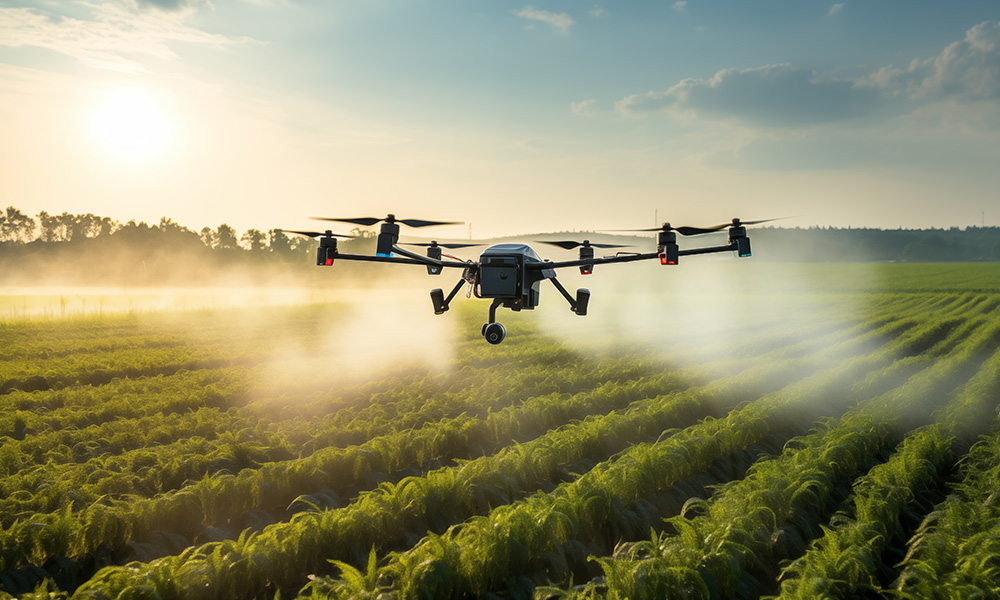
Spraying, Seeding & Livestock Monitoring: This remains the leading application area accounted for the largest share of the market. Crop spraying with drones is gaining momentum globally due to its cost efficiency, faster turnaround, and ability to access difficult terrain. Moreover, the use of drones for aerial seeding of cover crops is growing in regenerative agriculture practices. In ranching regions, drones equipped with thermal sensors are being used for herd tracking, calving supervision, and even predator detection, adding a new dimension to drone utility beyond crops. The adoption of drones with spraying payloads is surging, especially in Asia, due to growing concerns over worker safety and chemical overuse. Drones offer ultra-precise applications, minimizing drift and enabling variable rate spraying (VRS). This is not just cost-effective but also aligns with global environmental goals, including reduced nitrate leaching and pesticide use. Innovations in electrostatic spraying and swarm drone technology are poised to redefine large-field chemical management in the coming years.
Field Mapping & Crop Health Monitoring: This remains the fast growing application area, driven by the need for hyper local intelligence. Drone-based field mapping allows creation of elevation models, moisture maps, and weed infestation zones. With the rise of AI and machine learning, these images are being used to generate prescriptions for fertilization and irrigation with sub-meter accuracy.
By Drone Range: Market Insights
Short-range drones (typically under 5 km) are the most widely deployed segment, especially in countries with smaller farm plots. These drones are suited for basic aerial imaging, crop scouting, and small-field operations where cost and ease of recharging outweigh the need for distance.
Medium and long range drones are becoming more relevant in regions with vast agricultural lands with more organized and commercial farming, such as in the U.S., Brazil, and parts of Europe. These platforms can survey large tracts of land without requiring multiple take-offs and landings, making them ideal for high-volume data collection, disease detection, and variable rate application across large farms.
By Drone Technology: Market Insights
Imaging (RGB, Multispectral, Thermal): Advanced imaging sensors remain the backbone of drone functionality. Multispectral sensors help monitor plant chlorophyll levels, enabling early detection of nutrient deficiency, disease, or drought stress. Thermal imaging is being adopted for irrigation monitoring in high-value crops like almonds, vineyards, and citrus fruits. Drone startups are increasingly bundling AI-powered image processing software, allowing farmers to receive actionable insights directly on mobile apps.
Regional: Market Insights
North America currently holds the lion’s share in the global agricultural drone market, thanks to its early adoption of precision agriculture and a well-established regulatory and funding ecosystem. In the United States, strong federal backing through agencies like the USDA has made a significant difference. Government programs now actively encourage the integration of drones into modern farming, offering financial assistance, pilot training programs, and streamlined regulations through FAA’s Part 107 guidelines. Additionally, agricultural extension services and cooperative research initiatives are helping farmers, especially in mid-size and large-scale operations to educate on how drones can optimize pesticide application, irrigation, and crop monitoring. The presence of leading agri-tech firms, drone manufacturers, and robust digital infrastructure further supports widespread adoption. These factors together create an environment that thrives innovation in the agriculture industry.
Globally, several countries are ramping up efforts to catch up. China, for instance, has become a powerhouse in agricultural drone production and usage, fuelled by government-led rural revitalization campaigns and tax subsidies for drone equipment. India is also making notable strides, with schemes such as the “Sub-Mission on Agricultural Mechanization (SMAM)” offering subsidies of up to 75% on drone purchases for farmer-producer organizations (FPOs). The Indian government’s “Drone Shakti” initiative and the launch of rural training programs like “Drone Didis” reflect a growing commitment to democratize drone technology across small size farms. These strategic moves, backed by targeted incentives and growing digital literacy in rural areas, are enabling the Asia-Pacific region to emerge as the fastest-growing market in this space.
Competitive Landscape
The agricultural drone market is becoming increasingly dynamic, shaped by a diverse group of players that range from tech giants to agile startups and even legacy agricultural equipment manufacturers. Industry leaders like DJI, PrecisionHawk, Parrot SA, Trimble, XAG, and AgEagle Aerial Systems have emerged at the forefront, each bringing a unique strength to the table. DJI has firmly established itself through its cost effective and scalable spraying drones series, which have gained popularity across both advanced and developing agricultural markets. On the other hand, Trimble is making its mark by combining drone technology with robust precision agriculture software, enabling farmers to make smarter, data-driven decisions throughout the crop lifecycle.
What’s driving this competition isn’t just better drone hardware, but the drones are getting smarter and more connected. Companies are increasingly investing in features like AI-powered image analytics, multispectral sensing, and cloud-based monitoring platforms. These advancements allow farmers to assess crop health, detect issues early, and optimize resource use with a level of precision that traditional methods can’t match.
To expand their reach and stay ahead, many of these companies are forging partnerships and acquiring complementary businesses. For example, AgEagle’s acquisition of senseFly has broadened its fixed-wing drone capabilities and strengthened its position in North America and Europe. Emerging players like XAG in China and Skysense in India are also making notable strides by tapping into government support programs that subsidize drone usage and provide operator training, especially for smallholder farmers. In parallel, the rise of “drone-as-a-service” models where farmers can rent drones instead of buying them—is gaining momentum in price-sensitive regions, further diversifying how drone technology is adopted. As regulations mature and the pressure to farm more efficiently grows, this competitive landscape will likely continue to evolve rapidly, creating new opportunities for innovation and impact.
AGRICULTURAL DRONE MARKET SNAPSHOT | |
Market size in 2024 | USD 3 Billion |
Market forecast in 2032 | USD 21 Billion |
Compound Annual Growth Rate (2025-2032) | 27%+ |
Historical Data (Years) | 2022-2024 |
Forecast Data (Years) | 2025-2032 |
Region Dominance (Regional Share %) | North America: >30% Share |
Country Dominance (Share %) | US: >25% Share |
Growth Drivers & Emerging Trends | Increasing demand for agricultural produce to feed rapidly growing world population Government Support and Subsidies for Smart Farming, globally AI’s growing influence in agriculture |
Segments Covered | By Mode of Operation, By Products & Services, By Component, By Applications, By Drone Range, By Drone Payload, By Farm Produce, By Farming Location, By Farming Type, By Farm Size, By Drone Technologies, and by Regions & Countries |
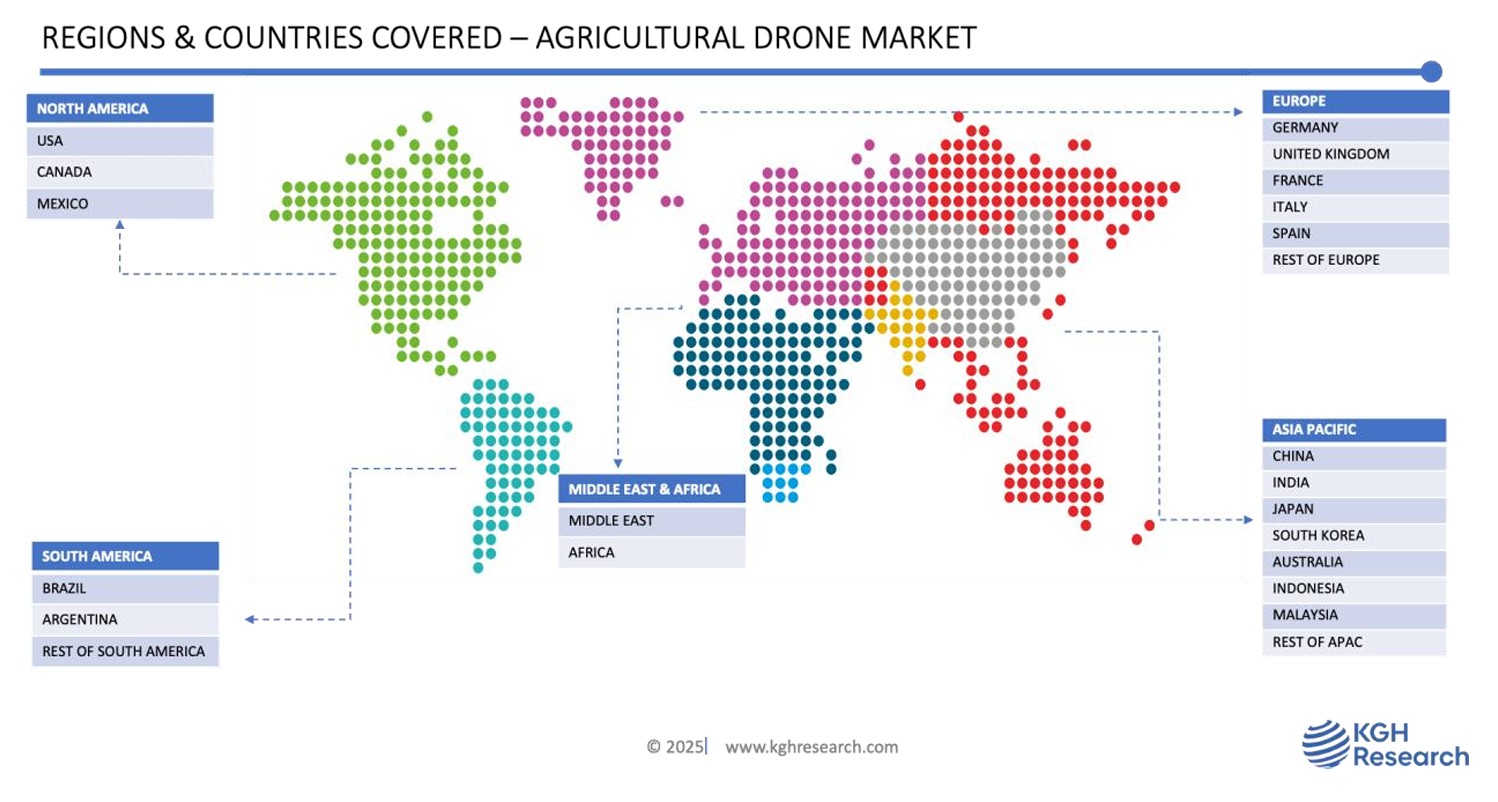
Regions Covered | North America, Europe, Asia Pacific, South America, Middle East & Africa |
Countries Covered | US, Canada, Mexico, The UK, Germany, Italy, France, Spain, Rest of the Europe, China, India, Japan, Australia, and Rest of APAC, Middle East, Africa, Brazil, Argentina, and Rest of South America |
Companies Profiled (25+) | DJI, PARROT, XAG, TRIMBLE, YAMAHA, AGEAGLE, SENTERA, AUTEL, YUNEEC, GAOKE, GUANGZHOU, ANYANG, GAMAYA, HYLIO, HIPHEN, SHENZHEN GC, SHENZHEN HI-TECH, DELAIR, SKY-DRONES, WINGTRA, JOUAV, ARIES SOLUTIONS, WUXI HANHE, VISION AERIAL, APPLIED AERONAUTICS. QYANTUM SYSTEMS, AND Many More |