
Managed Security Services Market (2022 - 2032)

MANAGED SECURITY SERVICES MARKET SIZE & SHARE BY COMPONENT (MANAGED FIREWALL, MANAGED VULNERABILITY, MANAGED IDENTITY & ACCESS, MANAGED DETECTION AND RESPONSE, MANAGED RISK & COMPLIANCE, MANAGED SIEM & LOG MANAGEMENT), BY SERVICES TYPE (LARGE, SME), BY SECURITY TYPE (CLOUD, NETWORK, APLICATION, ENDPOINT), BY END USE (BFSI, RETAIL, HEALTHCARE, TELECOMMUNICATION, ENERGY UTILITIES, MANUFACTURING, GOVERNMENT, IT & IT-ENABLED SERVICES) BY REGION & COUNTRY – FORECAST TO 2032
| Report Code: HC9001- | Number of Pages: 400 | Report Format: PDF, EXCEL, PPT |
|---|---|---|
|
Trend Year: 2022 – 2024 |
Forecast Period: 2025 – 2032 |
Publish Date: SEPTEMBER 2025 |
- Report Summary
-
Tables of Content
- Segmentation
- Methodology
- User License & Pricing
- Sample Copy
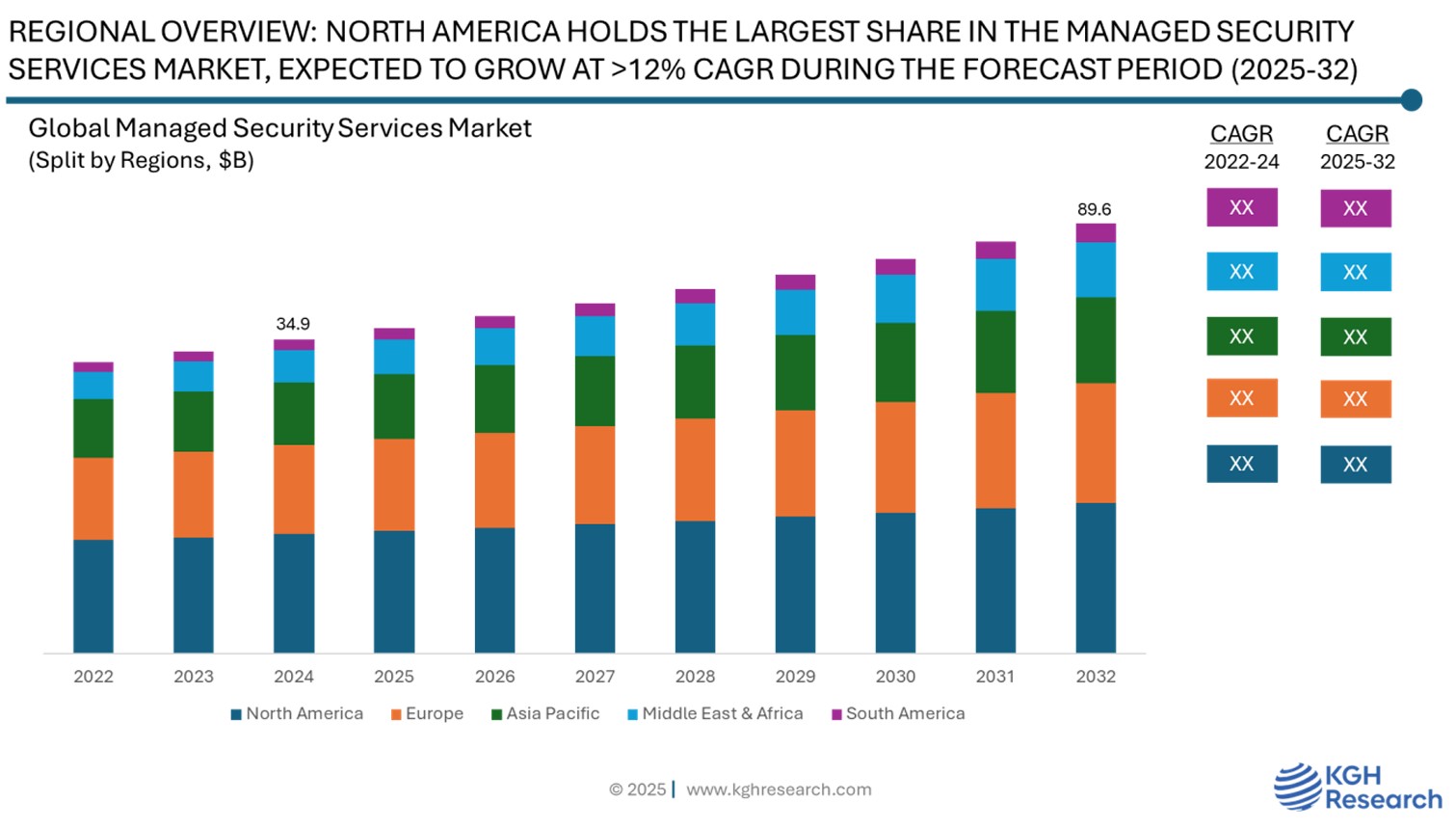
Market Overview: The global managed security services market was valued at approximately USD 35 billion in 2024 and is projected to grow at a compound annual growth rate (CAGR) of 12.5% from 2025 to 2032. The market is mainly driven by the rising number and complexity of cyberattacks. These threats push organizations to look for expert help with ongoing threat monitoring and incident response. The increasing complexity of IT systems, fueled by cloud use, remote work, and the growth of IoTs, has made it hard for smaller companies to manage security on their own. As regulatory requirements for data privacy and cybersecurity become stricter worldwide, businesses are relying on managed security providers to stay compliant and lower their risks.
MARKET DYNAMIC
GROWTH DRIVERS:
- Increasing frequency, sophistication, and impact of cyberattacks drive demand for 24/7 security monitoring and response
- Shortage of skilled cybersecurity professionals
- Stringent data protection laws require constant monitoring, reporting, and threat management
- Rapid adoption of cloud & IoTs
NEW GROWTH OPPORTUNITIES:
- Growing awareness in Asia-Pacific, Middle East, Africa, and among SMEs presents a large untapped market opportunity
- AI & automation in security
- Tailored managed security services for verticals like healthcare, BFSI, and manufacturing are gaining traction
MARKET RESTRAINTS:
- Concerns over data privacy and control
- High dependence on external vendors
- Integration complexity
GROWTH HURDLES:
- Evolving threat landscape
- Regulatory variability across regions
- Maintaining service quality at scale
- Customer trust and transparency
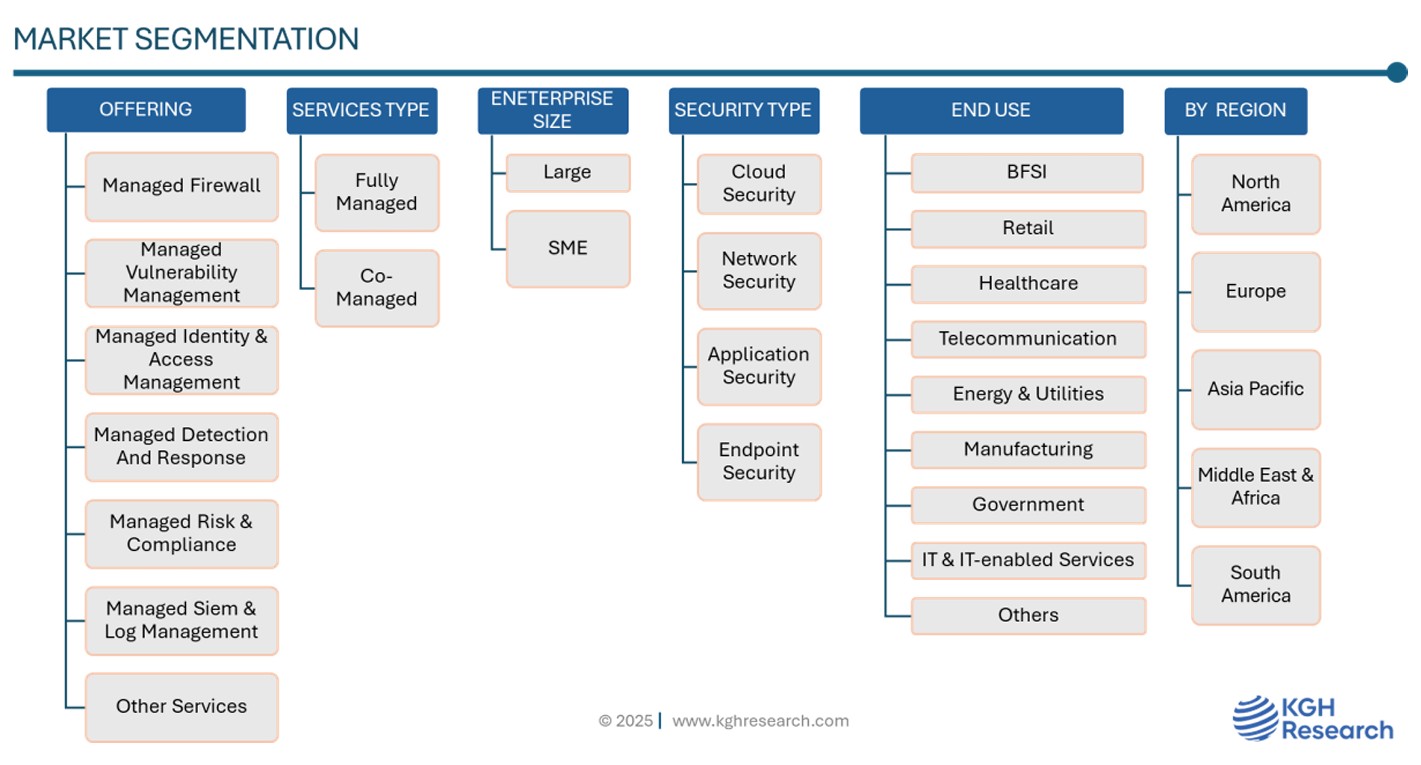
Offering: Market Insights
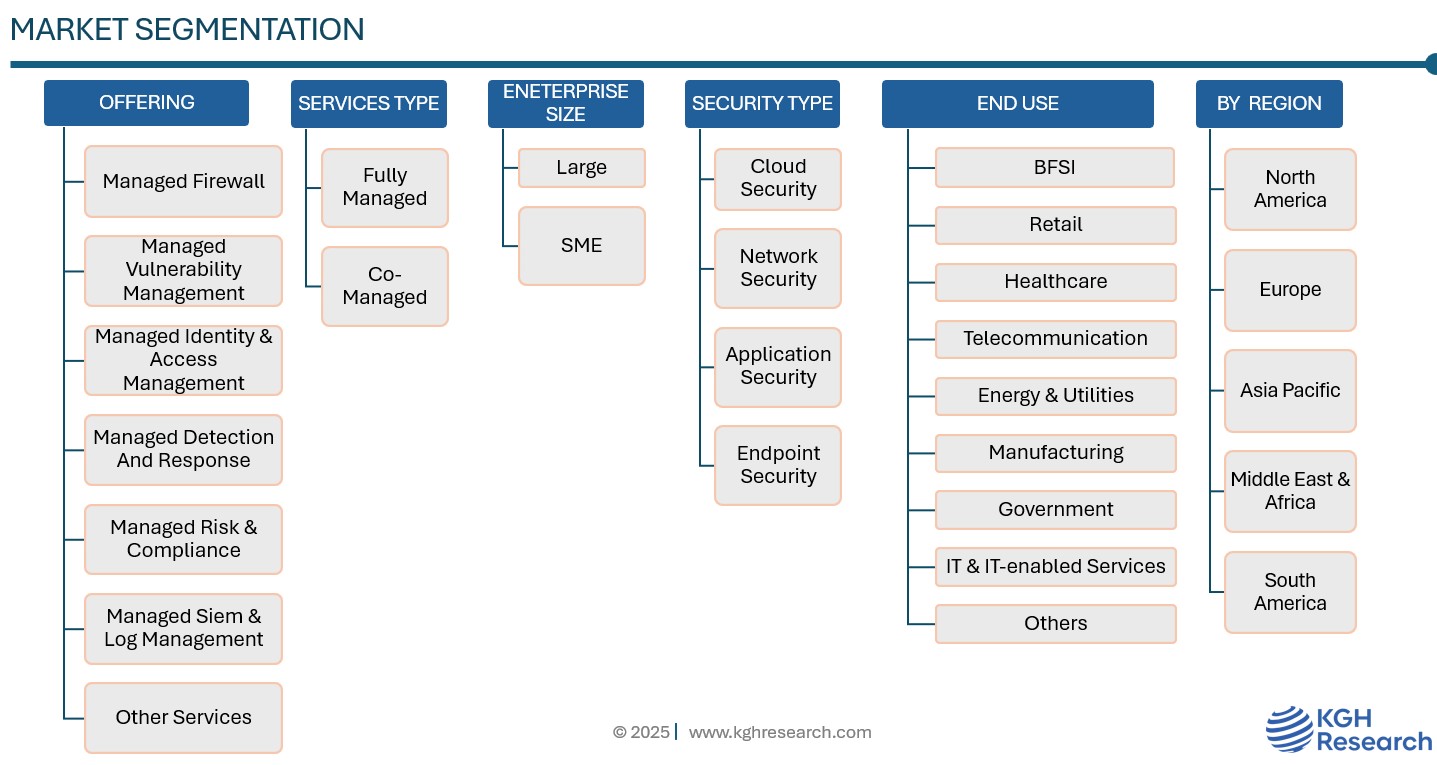
The global Managed Firewall market is an important part of the larger Managed Security Services industry. It is divided into several key security functions. Managed Vulnerability Management focuses on finding and fixing security weaknesses in networks and systems. Managed Identity & Access Management ensures secure access to IT resources by verifying users and controlling their privileges. Managed Detection and Response offers continuous monitoring, detection, and quick response to threats through advanced analysis and expert help. Managed Risk & Compliance services assist organizations in meeting regulatory requirements and lowering operational and cybersecurity risks using structured governance frameworks. Lastly, Managed SIEM & Log Management provides centralized monitoring and analysis of security events. This allows for real-time visibility of threats and forensic investigation. Together, these segments create a strong approach to managed firewall protection. They help businesses protect their digital assets while outsourcing complicated security tasks to specialized providers.
Service Type: Market Insights
By service type, the global managed security services market is divided into fully managed and co-managed services. The fully managed segment holds the largest market share. This is mainly because small and medium-sized businesses increasingly depend on outside security providers to handle their entire cybersecurity setup. These companies often do not have the in-house skills or resources needed. Fully managed services provide complete security management, which include threat monitoring, incident response, compliance, and reporting. This makes them a simple and cost-effective choice. In contrast, co-managed services, where duties are shared between internal IT teams and service providers, are growing faster. Large companies particularly like this option. They want external help but still want to keep control over some security functions in complex, hybrid systems.
Enterprise Size: Market Insights
By enterprise size, the global managed security services market is segmented into small and medium-sized enterprises and large enterprises. Large enterprises currently hold the dominant share of the market due to their extensive IT infrastructure, greater cybersecurity budgets, and increased exposure to sophisticated cyber threats. These organizations often face strict regulatory requirements and rely on managed security service providers to ensure continuous protection and compliance across multiple locations and systems. However, SMEs are emerging as a high-growth segment, driven by the rising frequency of cyberattacks on smaller businesses and the growing awareness of the need for professional security solutions. With limited internal resources, SMEs are increasingly turning into cost-effective, fully managed security services to protect their data and digital operations.
Security Type: Market Insights
By security type, the global managed security services market is divided into cloud security, network security, application security, and endpoint security. Among these, network security has the largest market share. This is driven by the growing need to protect complex enterprise networks from evolving cyber threats like intrusion attempts, DDoS attacks, and ransomware. With the rise in remote work and cloud-based operations, cloud security is seeing rapid growth. Organizations want to secure their cloud infrastructure, data, and applications across public, private, and hybrid environments. Endpoint security is also gaining ground due to the increasing number of mobile devices, laptops, and IoT endpoints that need ongoing monitoring and protection. At the same time, application security is becoming more crucial as businesses adopt more digital services and web-based platforms. This means they need managed solutions to protect software applications from vulnerabilities during their development and deployment.
End Use: Market Insights
By security type, the global managed security services market is divided into cloud security, network security, application security, and endpoint security. Among these, network security has the largest market share. This is driven by the growing need to protect complex enterprise networks from evolving cyber threats like intrusion attempts, DDoS attacks, and ransomware. With the rise in remote work and cloud-based operations, cloud security is seeing rapid growth. Organizations want to secure their cloud infrastructure, data, and applications across public, private, and hybrid environments. Endpoint security is also gaining ground due to the increasing number of mobile devices, laptops, and IoT endpoints that need ongoing monitoring and protection. At the same time, application security is becoming more crucial as businesses adopt more digital services and web-based platforms. This means they need managed solutions to protect software applications from vulnerabilities during their development and deployment.
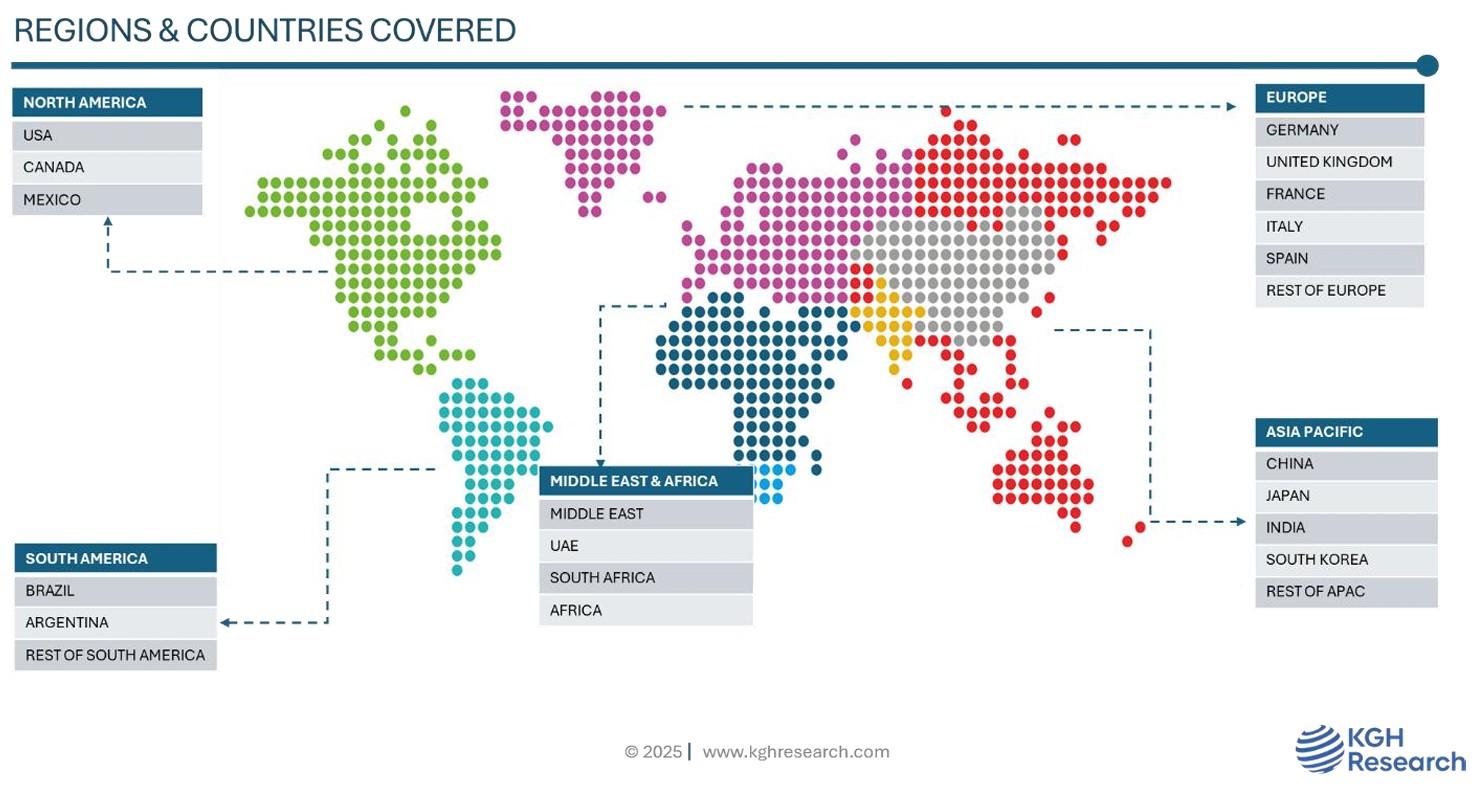
Regional: Market Insights
North America is the largest market for managed security services. This growth comes from strong digital infrastructure, a high number of complex cyber threats, and strict compliance requirements. The region, especially the United States, faces frequent and complicated cyberattacks that target key sectors like banking, healthcare, government, and energy. This ongoing threat has pushed organizations to use managed security solutions for real-time monitoring, threat detection, and incident response. North America also hosts many top managed security service providers, including IBM, AT&T, Cisco, and Palo Alto Networks. These companies offer advanced technologies and support 24/7. The region’s significant focus on cloud use, IoT integration, and remote work has widened the attack surface. This makes managed services vital for protecting hybrid and cloud-based environments. Additionally, strict data protection laws such as HIPAA, SOX, and CCPA require ongoing compliance monitoring, which managed security service providers can effectively deliver. These factors together make North America the most developed and dominant market for managed security services worldwide.
Competition: Managed security services market
The Managed security services market is highly competitive, with key players focusing on innovation, product efficiency, and strategic partnerships to strengthen their market position. Major companies include IBM, AT&T, DXC Technologies, Fujitsu, Accenture, Orange Cyberdefense, CISCO, Kudelski Security, Trustwave. These players are investing in R&D to develop managed security services market tailored for BFSI, Retail, healthcare, hospitality, government, manufacturing, telecommunication and other applications, driving ongoing competition and technological advancement in the market.
IBM, AT&T, DXC Technologies, Fujitsu, Accenture, Orange Cyberdefense, CISCO, Kudelski Security, Trustwave are among the leading companies active in the market.
IBM Corporation is known as one of the leading players in the global managed security services market. It offers a wide range of solutions that cover threat detection, incident response, compliance management, and risk assessment. Based in Armonk, New York, IBM has established one of the largest global footprints in cybersecurity. It operates state-of-the-art Security Operations Centers (SOCs) across North America, Europe, Asia, and Latin America. IBM’s managed security services rely on its sophisticated platforms, including IBM QRadar SIEM, IBM Security X-Force Threat Intelligence, and IBM Security QRadar SOAR. These tools provide real-time threat monitoring, analytics, and automated incident response. Through IBM Security Services, the company offers complete protection for cloud, on-premises, and hybrid environments. These solutions are designed for various industries, including BFSI, healthcare, manufacturing, and government.
IBM focuses on security by using AI and automation. It employs technologies like Watson for Cybersecurity to reduce alert fatigue and speed up response times. The company plays a significant role in the Zero Trust and cloud security movements, assisting businesses in modernizing their cybersecurity measures while ensuring they meet regulatory requirements. With a strong history of innovation, a global presence, and extensive expertise, IBM leads the managed security services market by helping organizations stay resilient against evolving cyber threats.
MANAGED SECURITY SERVICES MARKET SNAPSHOT | |
Market size in 2024 | USD 34.9 Billion |
Market forecast in 2032 | USD 89.6 Billion |
Compound Annual Growth Rate (2025-2032) | 12.5% |
Historical Data (Years) | 2022-2024 |
Forecast Data (Years) | 2025-2032 |
Segments Covered | Offering, Service Type, Enterprise Size, Security Type, End Use |
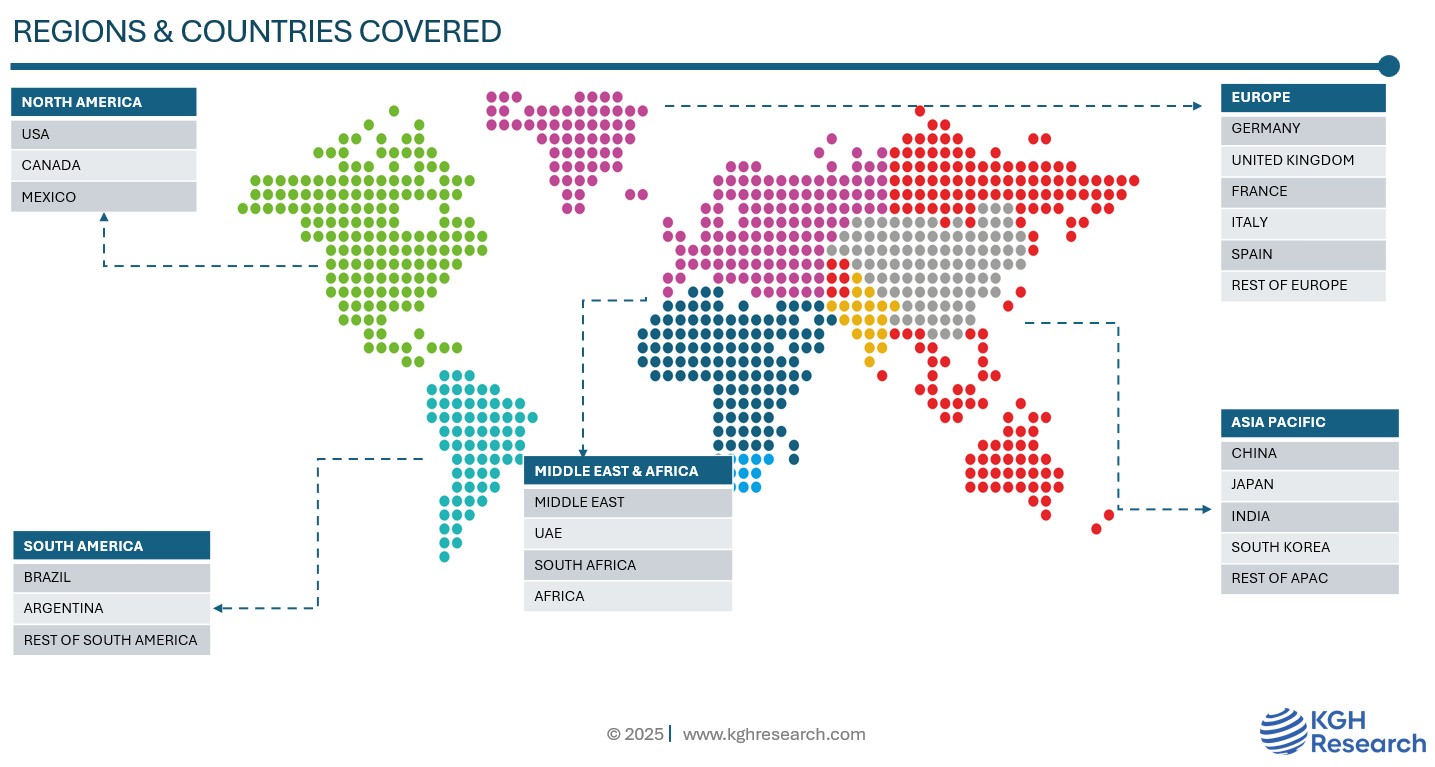
Regions Covered | North America, Europe, Asia Pacific, South America, Middle East & Africa |
Countries Covered | US, Canada, Mexico, UK, Germany, Italy, China, India, Japan, South Korea, South Africa, UAE, Saudi Arabia, Brazil, Argentina |
Companies Profiled | IBM, AT&T, DXC TECHNOLOGIES, FUJITSU, ACCENTURE, ORANGE CYBERDEFENSE, CISCO, SECUREWORKS, TRUSTWAVE, CAPGEMINI, HPE, TCS, KUDELSKI SECURITY, ATOS, DIGITALXRAID, AVERTIUM, WIPRO, PALO ALTO NETWORKS, RAPID7, VERIZON, TRUSTNET, TREND MICRO, LIGHTEDGE, CYFLARE, CROWDSTRIKE, ASCEND TECHNOLOGIES, CIPHER SECURITY, KROLL, RSI SECURITY, SECURITYHQ, NTT, LUMEN TECHNOLOGIES AND OTHERS |