
Dubai and Abu Dhabi act as regional gateways due to their established connectivity and international business hub status.
At KGH Research,
We track all the key megatrends shaping the respective industry & its impact on client’s business.
UAE vs Saudi Arabia: The Race to Become the Middle East Data Center Leader
Introduction
The Middle East is seeing rapid growth in digital infrastructure due to rising demand for cloud computing, artificial intelligence, and large digital platforms. In this shift, two countries are standing out as the main competitors in regional infrastructure: the United Arab Emirates and Saudi Arabia.
Both nations are investing heavily in large facilities, strong connectivity networks, and national digital transformation programs. As a result, the UAE data center market and the Saudi Arabia data center market are growing quickly, making the Gulf region a rising global hub for cloud and AI infrastructure.
Infrastructure Capacity and Development
Infrastructure capacity is a key factor in the regional competition. The UAE has established itself as one of the most developed digital infrastructure markets in the Middle East.
Cities like Dubai and Abu Dhabi have a high concentration of large and enterprise facilities. These Dubai data centers cater to both regional and international companies, supporting cloud services, financial technology platforms, and large digital applications.
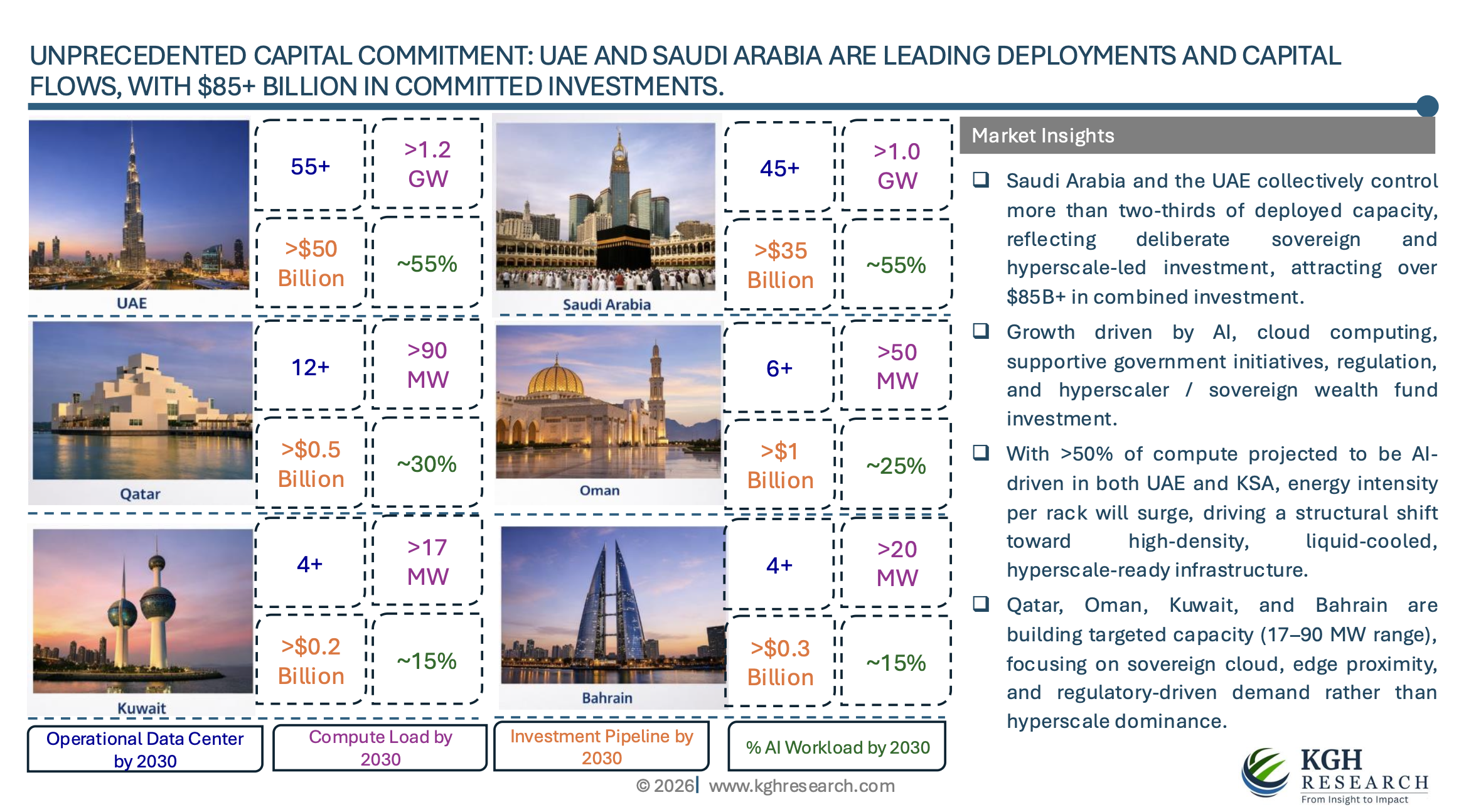
Industry projections indicate that the UAE could reach approximately 1.2 GW of data center capacity by 2030, strengthening its role as a key digital infrastructure hub in the region.
Saudi Arabia is also quickly increasing its capacity by building new digital zones, large campuses, and cloud regions. Major infrastructure projects are underway to meet the country’s growing demand for cloud computing and AI-powered services.
Investments Driving Market Expansion
Large investments from global technology companies and infrastructure providers are driving growth in both markets.
In the uae data center market international cloud providers and tech firms are expanding their presence by launching regional cloud platforms and building advanced data center facilities. The country’s strong connectivity and established digital ecosystem position it as a natural gateway for serving businesses across the Middle East and Africa.
Similarly, Saudi Arabia’s data center market is experiencing significant investment as the country develops large digital infrastructure projects. Initiatives backed by the government and sovereign wealth funds are promoting the creation of new technology zones and large-scale data centers to host cloud platforms and AI workloads.
Government Programs Supporting Digital Growth
Government strategies play a crucial role in speeding up infrastructure development in both countries.
The UAE is concentrating on creating a strong digital economy by promoting cloud adoption, smart city projects, and technology innovation. Major cities like Dubai are investing in digital infrastructure to attract global technology companies and enhance the country’s status as a regional tech hub.
In Saudi Arabia, national programs like Saudi Vision 2030 aim to diversify the economy and develop advanced technology sectors. These initiatives are driving significant investments in cloud computing, artificial intelligence, and large infrastructure development throughout the country.
Strategic Role in the Middle East Digital Ecosystem
The competition between the UAE data center market and the Saudi Arabia data center market is shaping the future of digital infrastructure in the Middle East. Currently, the UAE leads with a developed ecosystem and strong international connectivity, but Saudi Arabia is rapidly investing in large-scale infrastructure as part of its long-term economic transformation.
With the UAE expected to reach around 1.2 GW of capacity by 2030 and Saudi Arabia speeding up its infrastructure investments, both countries are poised to play a significant role in the future of the regional data center industry.
Full comparison available in the GCC Data Center Market Report
https://kghresearch.com/gcc-data-center-market/
Conclusion:
The competition between the UAE data center market and the Saudi Arabia data center market is shaping the future of digital infrastructure in the Middle East. Currently, the UAE leads with a developed ecosystem and strong international connectivity, but Saudi Arabia is rapidly investing in large-scale infrastructure as part of its long-term economic transformation.
With the UAE expected to reach around 1.2 GW of capacity by 2030 and Saudi Arabia speeding up its infrastructure investments, both countries are poised to play a significant role in the future of the regional data center industry.
Full comparison available in the GCC Data Center Market Report
https://kghresearch.com/gcc-data-center-market/
Frequently Asked Questions
1. Who is leading?
The UAE currently leads with a more developed ecosystem, but Saudi Arabia is catching up fast through massive new investments.
2. What is the UAE’s capacity goal?
The UAE aims to hit 1.2 GW of data center capacity by 2030.
3. What drives Saudi growth?
Saudi Vision 2030 and government-backed funds are the primary drivers for their infrastructure expansion.
4. Why are UAE cities central?
5. Role of Cloud & AI?
Both nations are building high-power facilities specifically to host regional cloud platforms and AI workloads.
6. Why the Gulf location?
Its position between Europe, Asia, and Africa makes it a perfect hub for global data routing.
7. Is competition beneficial?
Yes; it accelerates digital transformation and attracts global tech giants to the entire Middle East.