
At KGH Research,
We track all the key megatrends shaping the respective industry & its impact on client’s business.
Data Center IT Cooling Market Size 2022-2035:
Introduction
The rapid growth of artificial intelligence, cloud computing, and large-scale data centers is changing the global cooling landscape. As compute density rises, cooling is becoming a vital part of the infrastructure.
This change is driving significant growth in the data center cooling infrastructure market size. Investments are pouring into CDUs, Heat Exchangers, Manifolds, QCDs, Cold Plates, Pumps, Valves, Pipes, Sensors, Flow Meters, Tanks, Chillers, Cooling Towers, Control Systems, Drives, CRAC / CRAH, Direct to Chip / Cold Plate Cooling, and Immersion Cooling Technologies.
From 2022 to 2035, the market is expected to expand quickly, driven by AI workloads, growth in hyperscale facilities, sustainability, and the need for energy-efficient infrastructure.
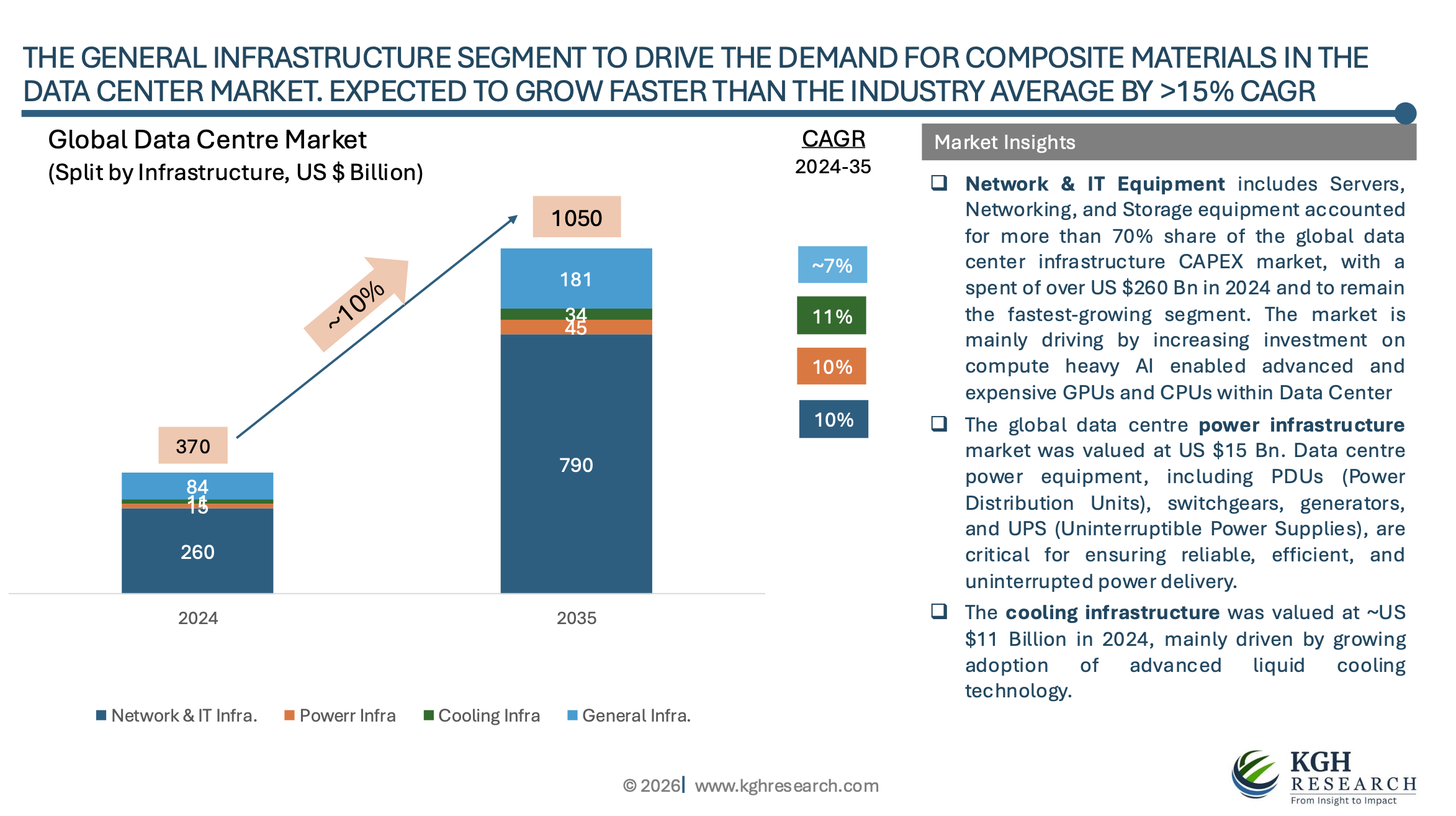
Market Overview: A Multi-Billion Dollar Growth Opportunity
The data center cooling market forecast shows strong double-digit growth over the next decade. As AI workloads increase rack densities, traditional air cooling is reaching its limits.
This accelerates the move toward liquid-based cooling systems. Consequently, the overall data center cooling infrastructure market size is set for significant growth across all major regions.
Key growth drivers include:
- Demand from AI and high-performance computing
- Expansion of hyperscale campuses
- Increased energy efficiency requirements
- Pressure from regulatory bodies on emissions and sustainability
Segment Breakdown: Where the Market Value Lies
Coolant Distribution Units (CDUs): The Backbone of the Liquid Cooling Systems
CDUs are crucial for circulating coolant in data center systems. As more facilities adopt liquid cooling, the demand for high-performance CDU systems is increasing.
This segment is growing due to:
- High-density AI workloads
- Increasing penetration of liquid cooling systems
- CDUs are becoming essential components in the overall cooling infrastructure.
Liquid Cooling Systems: The Fastest Growing Segment
The liquid cooling market is projected to be the fastest-growing segment in the cooling infrastructure space.
Unlike traditional air cooling, liquid systems can manage much higher heat loads, making them suitable for AI and high-density setups.
Key technologies include:
- Direct-to-chip cooling
- Immersion cooling
- Rear-door heat exchangers
As AI adoption grows, liquid cooling is becoming essential for modern data centers.
Regional Outlook: Where Growth Is Concentrated
The growth of the data center cooling infrastructure market size is driven by a few key regions
- North America: Leading in hyperscale and AI deployments
- Asia-Pacific: Fastest growth due to digital expansion
- Middle East: Emerging market boosted by government AI investments
Challenges in Market Growth
- Despite growing demand, several challenges remain:
- High initial costs of advanced cooling systems
- Complexity of integrating liquid cooling into existing facilities
- Limited availability of skilled professionals
Addressing these issues will be important for long-term growth.
Conclusion:
The data center cooling infrastructure market size is poised for significant growth between 2026 to 2035, driven by AI, expansion in hyperscale facilities, and the shift to liquid cooling technologies.
From CDUs, to pumps, valves, QCDs, RDHx, manifolds, chillers, cooling towers, sensors, flow meters, cold plates, VFDs, to the final cooling systems and modern cooling architectures, every part of the ecosystem is evolving to meet the needs of next-generation data centers.
As the data center cooling market forecast continues to improve, companies that invest in innovation, efficiency, and AI-ready solutions will be well-positioned to seize this growing opportunity.
Frequently Asked Questions
1. What is real-time monitoring in data centers?
Continuous tracking of temperature, power, and system performance with instant alerts.
2. Why is real-time monitoring important?
It prevents downtime and ensures smooth, reliable data center operations.
3. How is it different from traditional monitoring?
Real-time monitoring is continuous and instant, unlike periodic manual checks.
4. What parameters are monitored?
Temperature, humidity, power usage, airflow, and equipment health.
5. How does it help AI workloads?
It manages heat instantly, keeping high-density systems stable.
6. What technologies are used?
IoT sensors, AI analytics, and DCIM software.