
Governments across the Gulf are launching digital transformation programs such as Saudi Vision 2030, which encourage technology investment, cloud adoption, and infrastructure development, helping accelerate the growth of data centers across the region.
At KGH Research,
We track all the key megatrends shaping the respective industry & its impact on client’s business.
Why the Middle East Is Becoming a Global Data Center Hub
Introduction
The Middle East is quickly becoming one of the fastest-growing areas for digital infrastructure. As global demand for cloud computing, AI workloads, and digital services rises, companies are looking beyond traditional hubs in North America, Europe, and Asia to grow their data center networks.
This change has brought the Middle East into discussions about new investments. Its strategic location, strong government support, and growing digital adoption are creating the right conditions for data center expansion in the region. As a result, the Middle East data center market is evolving into a key hub for global cloud and AI infrastructure.

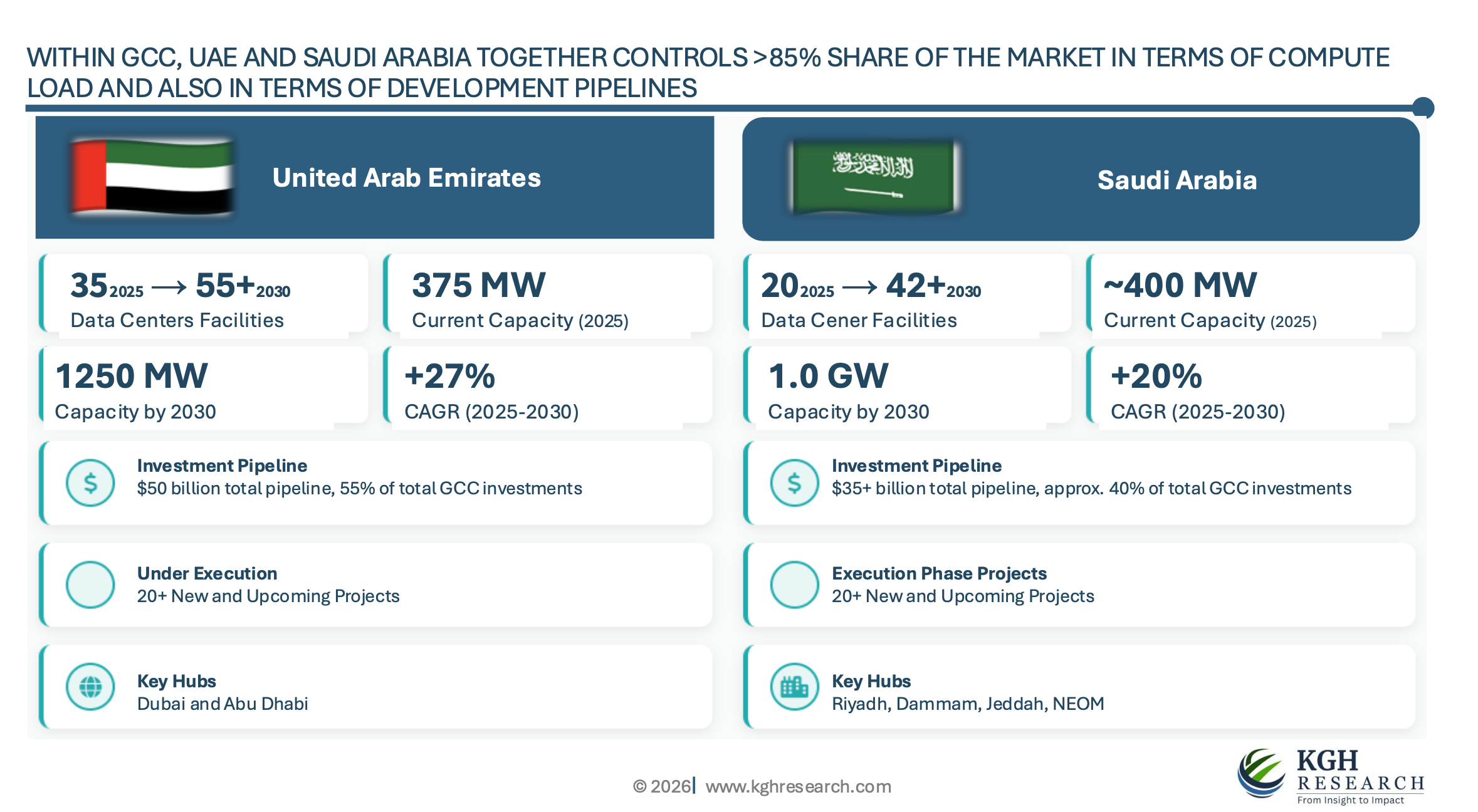
Strategic Location Connecting Global Markets
One major advantage of the Middle East’s cloud infrastructure is its strategic geographic position. The region sits at the crossroads of Europe, Asia, and Africa, making it an ideal center for global data routing and connectivity. Major cities like Dubai, Riyadh, and Abu Dhabi are becoming critical digital gateways that link businesses and internet users across continents. For global tech companies, this location helps cut down latency and improves the delivery of cloud services to fast-growing markets.
Why Data Center Growth Is Accelerating
Several key factors are speeding up the growth of the Middle East data center market. First, the region has strong energy resources. Countries like Saudi Arabia and the United Arab Emirates have significant power generation capacity, which is essential for operating energy-intensive data center infrastructure. Second, governments in the Gulf Cooperation Council are investing heavily in digital transformation. Initiatives such as Saudi Vision 2030 aim to diversify economies and build strong digital ecosystems.
Third, demand for digital services in the region is rising quickly. Businesses are adopting cloud computing, governments are developing smart city systems, and consumers are increasingly turning to digital platforms. Together, these factors are creating strong demand for new data centers in the Middle East.
Why Global Companies Are Investing
Global tech companies view the Middle East as a high-growth market for infrastructure. Major cloud providers like Amazon Web Services, Microsoft, and Google are expanding their presence in the region by launching new cloud regions and building large-scale facilities.
These investments are strengthening the Middle East’s cloud infrastructure while supporting businesses that need reliable and scalable digital services. For investors and infrastructure companies, the region offers a long-term opportunity as demand for AI computing, cloud platforms, and digital connectivity continues to grow.
Conclusion:
The growth of the Middle East data center market is driven by a strong mix of strategic location, abundant energy resources, government support, and rapid digital transformation. As global demand for cloud and AI infrastructure increases, the Middle East is becoming a more important part of the global digital economy. Companies that invest early in this expanding ecosystem are positioning themselves at the forefront of the next wave of digital development.
Frequently Asked Questions
Why is the Middle East attracting data center investments?
The Middle East is attracting data center investments due to its strategic location between Europe, Asia, and Africa, strong government support for digital transformation, growing demand for cloud services, and access to reliable energy resources needed to power large data facilities.
2. Which Middle Eastern countries are leading data center development?
Countries such as the United Arab Emirates, Saudi Arabia, and Qatar are leading data center development due to strong infrastructure investments, supportive government policies, and increasing demand for cloud and AI services.
3. Why are global cloud companies expanding in the Middle East?
Major cloud providers like Amazon Web Services, Microsoft, and Google are expanding in the Middle East to serve growing digital markets, reduce latency for regional users, and support the rapid adoption of AI, cloud computing, and digital services
4. How does government policy support data center growth in the region?
5. How is AI driving data center growth in the Middle East?
AI applications require high-performance computing and large data processing capabilities, increasing demand for advanced data center infrastructure across the region.
6. Which industries are creating demand for data centers in the Middle East?
Sectors like finance, healthcare, e-commerce, telecom, and government services are rapidly adopting cloud technologies, increasing the need for reliable data centers.
7. Which cities are emerging as major data center hubs in the Middle East?
Cities such as Dubai, Riyadh, and Abu Dhabi are becoming key data center and digital infrastructure hubs in the region.